Tudor Church Militant by Diarmaid MacCulloch
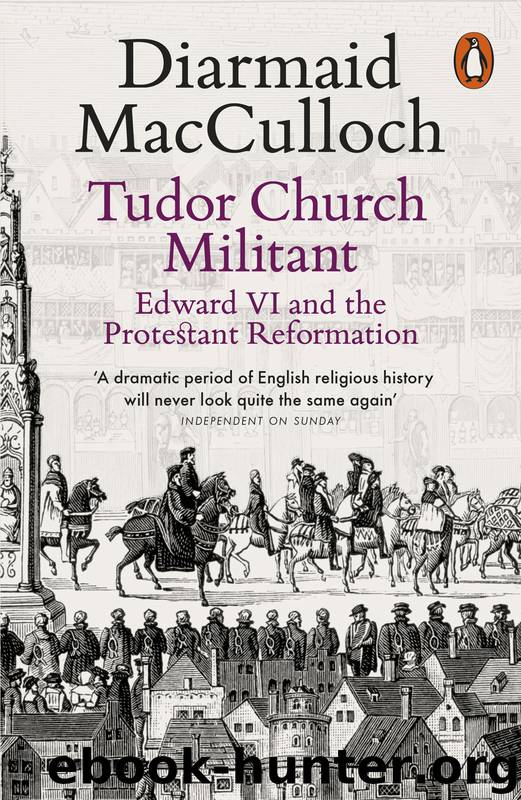
Author:Diarmaid MacCulloch
Language: eng
Format: epub
ISBN: 9780141985084
Publisher: Penguin Books Ltd
Published: 2017-07-05T16:00:00+00:00
48. William Parr, 1st Marquis of Northampton, a drawing by Hans Holbein the Younger, 1541–2, made during his first marriage.
49. The burning of Anne Ayscough and other evangelicals, summer 1546, with as a backdrop the church of St Bartholomew the Great, Smithfield, and with members of the Privy Council getting a grandstand view. Bishop Nicholas Shaxton, an evangelical leader whose nerve had broken, is preaching his recantation to the martyrs from the pulpit within the arena. Note the scenes of drunken debauchery in the detail of the foreground; conservatives might retort that Ayscough had shown equal immorality in walking out of her marriage. John Foxe took this picture from Robert Crowley’s attack on Bishop Shaxton and reused it in his Acts and Monuments.
Miles Huggarde singled out a passage from the first epistle to Timothy as being a favourite evangelical theme: this is an attack on liars who forbid marriage and enjoin abstinence from certain foods, and it affirms the goodness of all things created by God. Huggarde said that the passage became a proof-text against compulsory clerical celibacy and fasting rules including Lent, and that it was one of the texts characteristically painted on church walls in Edwardian England.65 So to preach liberty in the Edwardian Church was very specifically to announce the triumph of carnival over Lent. Dean Christopherson also picked up the carnival theme of inversion in deploring what he termed ‘the Lutherans libertie’ in Edwardian England: ‘vice ruled virtue, and foolishness ruled wisdom, lightness ruled gravity, and youth ruled age’.66 This is the cry of outraged authority throughout the ages; but many more would enjoy the carnival.
The Edwardian age began as one of glasnost, with the abolition of the heresy laws and the lapse of censorship, and it remained a period where there was an extraordinary degree of theological discussion, both formal and informal. The evangelical establishment constrained conservative voices, but protests were not suppressed altogether even after the shift in power to evangelicals in 1549. Moreover, it is not making a cheap point to note that the consequences for conservatives taking part in Edwardian public debate were a good deal less dire than they were for Protestants in Mary’s reign. The evangelical leadership retained something of the reasonableness of Erasmian humanism when it argued with its opponents. It was not entirely an empty or boastful piety when Dr Richard Cox announced to the conservatives in his audience in the Oxford Divinity School after the summer 1549 eucharistic debate: ‘we have the power to give orders to you by authority, and threaten deserved punishment to the stubborn, but we prefer to entreat and exhort, in consideration of our high esteem for you’.67
It is also notable that much of the discussion encouraged in Edwardian England involved laity as well as clergy. One might expect Oxford and Cambridge to host disputations like those of 1549, particularly given the presence of internationally renowned theologians like Martyr and Bucer, but the House of Lords debate on the eucharist in December 1548 had less precedent in England, including as it did both lay and clerical political leaders.
Download
This site does not store any files on its server. We only index and link to content provided by other sites. Please contact the content providers to delete copyright contents if any and email us, we'll remove relevant links or contents immediately.
| Anthropology | Archaeology |
| Philosophy | Politics & Government |
| Social Sciences | Sociology |
| Women's Studies |
The remains of the day by Kazuo Ishiguro(8999)
Tools of Titans by Timothy Ferriss(8393)
Giovanni's Room by James Baldwin(7346)
The Black Swan by Nassim Nicholas Taleb(7129)
Inner Engineering: A Yogi's Guide to Joy by Sadhguru(6793)
The Way of Zen by Alan W. Watts(6614)
The Power of Now: A Guide to Spiritual Enlightenment by Eckhart Tolle(5781)
Asking the Right Questions: A Guide to Critical Thinking by M. Neil Browne & Stuart M. Keeley(5775)
The Six Wives Of Henry VIII (WOMEN IN HISTORY) by Fraser Antonia(5515)
Astrophysics for People in a Hurry by Neil DeGrasse Tyson(5189)
Housekeeping by Marilynne Robinson(4446)
12 Rules for Life by Jordan B. Peterson(4304)
Ikigai by Héctor García & Francesc Miralles(4274)
Double Down (Diary of a Wimpy Kid Book 11) by Jeff Kinney(4271)
The Ethical Slut by Janet W. Hardy(4251)
Skin in the Game by Nassim Nicholas Taleb(4248)
The Art of Happiness by The Dalai Lama(4130)
Skin in the Game: Hidden Asymmetries in Daily Life by Nassim Nicholas Taleb(4006)
Walking by Henry David Thoreau(3962)
